Buying or Selling Property Owned by an IBC in St. Lucia: What You Must Know
Property transactions involving companies—especially International Business Companies (IBCs)—are common in Saint Lucia, particularly for luxury villas, investment properties, and estate planning structures.
However, buying or selling a property owned by an IBC is not the same as a standard residential transaction. In fact, misunderstanding the rules around corporate ownership is one of the most common causes of delays, failed closings, and unexpected taxes.
This guide explains how IBC ownership works in practice, what approvals are required, and how to avoid costly mistakes.
What Is an IBC in St. Lucia?
An International Business Company (IBC) is a corporate entity often used by foreign investors for:
Asset holding
Estate planning
Confidentiality
Cross-border investment
In St. Lucia, property may be owned by:
An IBC
A locally incorporated limited liability company
A foreign company registered to operate locally
Each structure carries different legal and tax consequences.
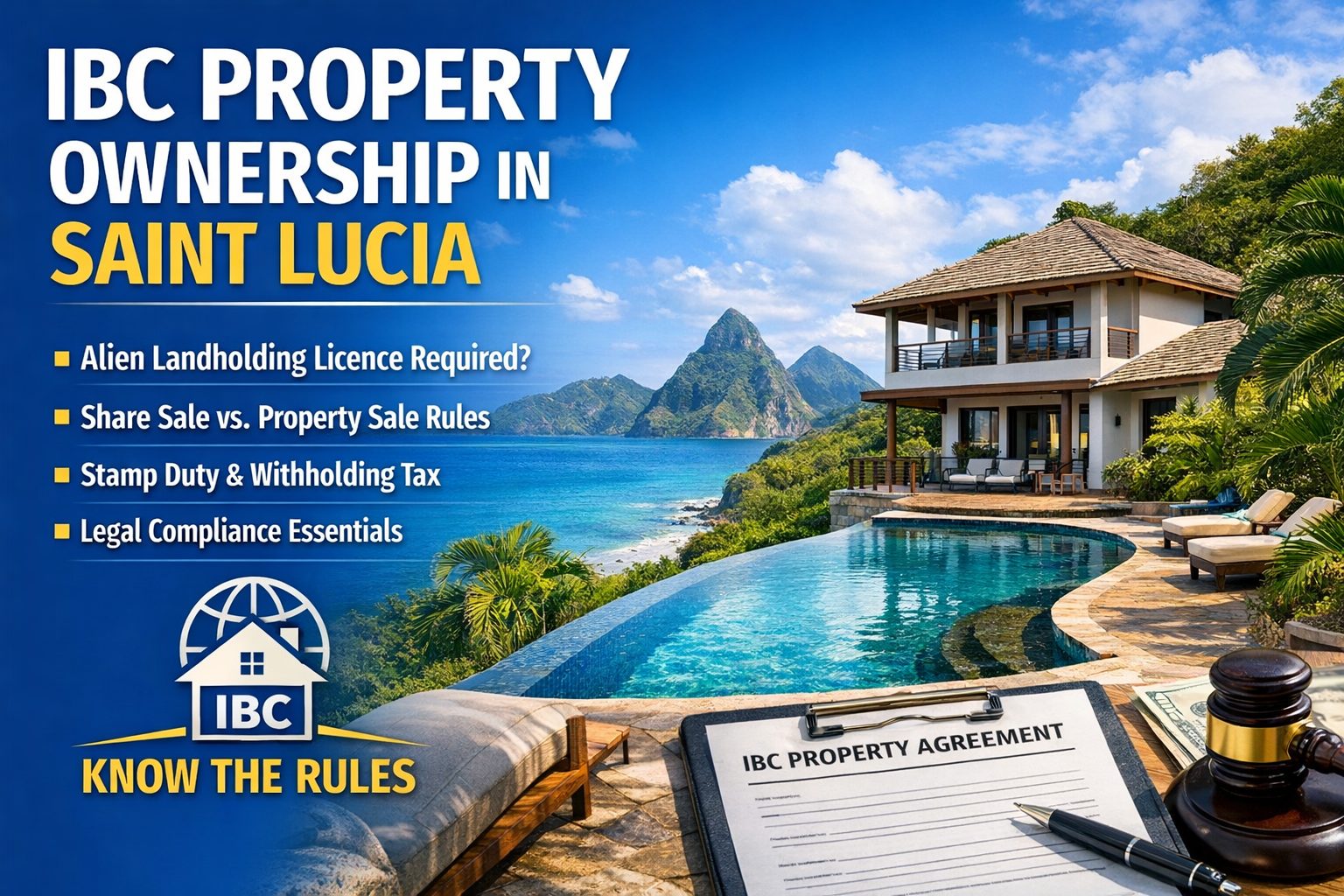
Does an IBC-Owned Property Require an Alien Landholding Licence?
The short answer: usually, yes.
If a company is:
Foreign-owned, or
Foreign-controlled (based on beneficial ownership),
then the transaction is treated as a foreign acquisition of land, even if:
The company is incorporated in St. Lucia
The buyer is purchasing shares instead of land
Authorities look at beneficial ownership, not just the name on the land register.
Share Sale vs Property Sale: A Common (and Costly) Myth
A widespread misconception is:
“We can sell the shares of the company and avoid Alien Landholding Licence approval.”
In reality:
If the company’s primary or sole asset is land, a share transfer may be treated as an indirect transfer of land
Government agencies may still require:
Alien Landholding Licence approval
Stamp duty assessment
Disclosure of beneficial ownership
Share sales do not automatically bypass regulation in St. Lucia.
Stamp Duty, Taxes & Withholding Risk
Stamp Duty
Stamp duty generally applies whether:
The land itself is sold, or
Shares are transferred where their value is derived mainly from land
There is no guaranteed tax saving simply by selling shares.
Capital Gains & Withholding Tax
St. Lucia does not levy a traditional capital gains tax, but gains may still be captured through:
Income tax (where the activity is considered trading), or
Withholding tax, especially where:
The seller is an IBC
The seller is non-resident
This is an area that must be addressed early, not at closing.
Bank, Legal & Compliance Requirements
When an IBC owns the property, attorneys and banks will typically require:
Certificate of incorporation
Articles and by-laws
Registers of directors and shareholders
Beneficial ownership declarations
Certificate of good standing
Board resolutions authorizing the sale
IBC transactions attract higher compliance scrutiny and usually take longer than individual sales.
What Happens in a Foreclosure Scenario?
If a property owned by an IBC goes before the court:
The court treats the asset as immovable property
Mortgage interest generally continues to accrue unless the court orders otherwise
A buyer at judicial sale will still need:
Alien Landholding Licence approval (unless exempt)
IBC ownership does not shield the property from foreclosure rules.
Common Mistakes to Avoid
Assuming a share sale avoids Alien Landholding Licence approval
Ignoring beneficial ownership disclosure requirements
Failing to budget for withholding tax
Listing an IBC-owned property without corporate compliance in place
Leaving tax structuring until the final stage
These mistakes regularly lead to collapsed transactions.
Best Practice: How to Structure IBC Property Transactions
To ensure a smooth transaction:
Clarify early whether the sale is asset-based or share-based
Confirm beneficial ownership before marketing
Align tax, legal, and licensing strategy upfront
Use attorneys experienced in corporate property conveyancing
Set realistic timelines for approvals and compliance
With proper planning, IBC-owned properties can be sold successfully—but they require structure, not shortcuts.
IBC ownership does not simplify real estate transactions in St. Lucia.
In most cases, it adds complexity—but not impossibility.
The key is early disclosure, correct structuring, and informed guidance.
If you are buying or selling a property owned by a company, professional advice at the start of the process can save months of delay and significant cost.
Need Help With an IBC-Owned Property?
If you’re dealing with:
A corporate-owned villa
A share sale vs land sale decision
Alien Landholding Licence questions
Tax or withholding exposure
Get expert guidance before signing an agreement. Contact Micha Landers
FAQ
H2: Frequently Asked Questions
Q1: Can I avoid an Alien Landholding Licence by buying company shares instead of land?
No. If the company’s main asset is land, a share sale may still be treated as an indirect transfer of property.
Q2: Does stamp duty apply to share sales involving IBC-owned property?
Yes, in many cases. Authorities assess substance over form where shares derive value from land.
Q3: Are IBC-owned properties harder to finance?
Yes. Banks apply stricter compliance and documentation requirements, which can extend timelines.
Q4: Is withholding tax payable when an IBC sells property in St Lucia?
It may apply, especially where the seller is non-resident. This should be addressed early in the transaction.
Q5: Can a court sell an IBC-owned property in foreclosure?
Yes. The court treats it as immovable property, and buyers may still require ALHL approval.